
Europe and India Test a Bold Technology Compact
By Dr. Arvind Dube
Bharatiya Abroad | Edited by Staff Writer | Updated: September 29, 2025 6:06 pm UTC
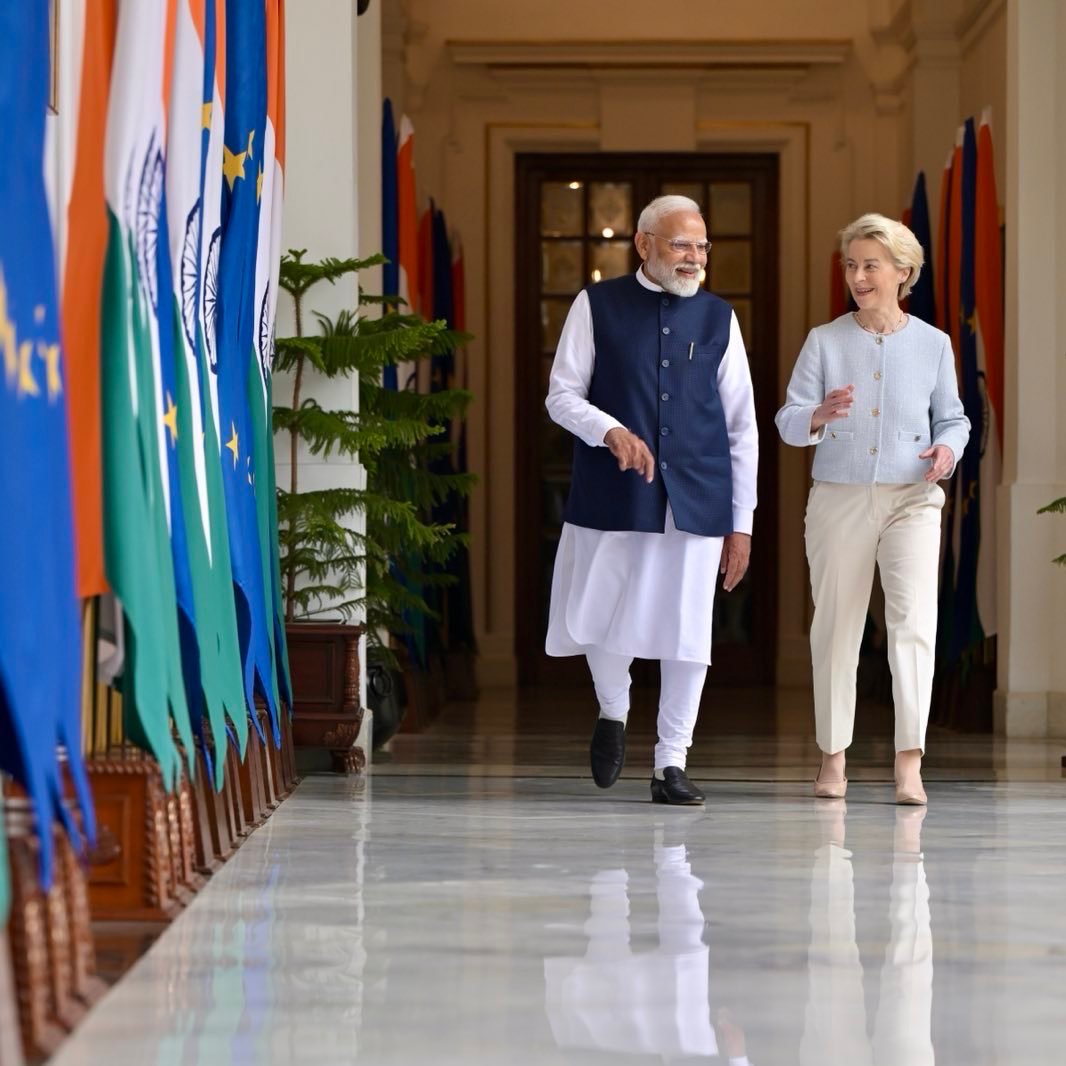
When Brussels and New Delhi set up the EU–India Trade and Technology Council (TTC) in 2022, it was hailed as a landmark: a structured forum for two major democracies to align on trade, technology, and clean energy. Modeled loosely on the EU–US TTC, it marked a shift in Europe’s Asia strategy and India’s global ambitions.
Three years later, the TTC is still in its infancy — but the stakes around it are far bigger than its modest beginnings suggest. In an era when technology sets the rules of power, the TTC is a test of whether middle powers can shape the global order on their own terms, rather than being forced to follow Washington or Beijing.
When Brussels and New Delhi set up the EU–India Trade and Technology Council (TTC) in 2022, it was hailed as a landmark: a structured forum for two major democracies to align on trade, technology, and clean energy. Modeled loosely on the EU–US TTC, it marked a shift in Europe’s Asia strategy and India’s global ambitions.
Three years later, the TTC is still in its infancy — but the stakes around it are far bigger than its modest beginnings suggest. In an era when technology sets the rules of power, the TTC is a test of whether middle powers can shape the global order on their own terms, rather than being forced to follow Washington or Beijing.
The Geopolitical Backdrop
The TTC’s timing is deliberate. It comes as:
- US–China rivalry turns supply chains into battlegrounds.
- The EU recalibrates its Indo-Pacific strategy, no longer willing to be dependent on Beijing.
- India balances between the Quad, IPEF, and G20 platforms, seeking to shape global standards while avoiding overdependence on any single partner.
By building a TTC with India, Europe signals its intent to diversify its Asia policy beyond China. For India, the TTC offers leverage — a platform to project power and showcase its digital public infrastructure model, from Aadhaar to UPI, as an alternative blueprint for the Global South.
Technology: The Big Bets
Semiconductors
Semiconductors are the TTC’s headline project. Europe controls about 10 percent of global production, with strengths in equipment and R&D. India, with a $10 billion incentive scheme, wants to build fabs and testing facilities. The TTC could link European know-how with Indian capacity, though early projects are more likely to focus on packaging and assembly.
Artificial Intelligence
Europe’s AI Act (2024) is the world’s first comprehensive law on artificial intelligence, while India is drafting its own framework with an innovation-first lens. TTC cooperation could create a democratic AI governance model, balancing regulation with growth.
Data and Cybersecurity
The EU’s GDPR regime clashes with India’s Digital Personal Data Protection Act (2023), which emphasizes localization and state access. These differences will test the TTC. On cybersecurity, however, there is clearer scope: joint drills, shared standards for 5G/6G, and critical infrastructure protection are likely next steps.
Climate and Energy: A Convergence of Interests
India has pledged 500 GW of renewable capacity by 2030, while the EU brings capital and advanced technology. The TTC can drive:
- Green hydrogen corridors linking Indian production to European demand.
- Cooperation on critical minerals recycling to reduce dependence on China.
- Joint leadership in climate diplomacy, especially ahead of COP30 in Brazil.
For both sides, climate cooperation is not just about economics but about shaping the narrative of global decarbonization pathways.
The FTA Question
The TTC cannot escape its biggest structural weakness: the absence of a free trade agreement. EU–India FTA talks, restarted in 2022 after an eight-year pause, have made progress — 60 percent of chapters are closed — but sensitive sectors remain unresolved.
The EU wants lower tariffs on cars, wines, and medical devices. India seeks access for its textiles, steel, pharmaceuticals, and IT services. Without an FTA, TTC projects risk being stranded in regulatory limbo. With an FTA, the TTC could gain real economic muscle.
The FTA Question
The TTC cannot escape its biggest structural weakness: the absence of a free trade agreement. EU–India FTA talks, restarted in 2022 after an eight-year pause, have made progress — 60 percent of chapters are closed — but sensitive sectors remain unresolved.
The EU wants lower tariffs on cars, wines, and medical devices. India seeks access for its textiles, steel, pharmaceuticals, and IT services. Without an FTA, TTC projects risk being stranded in regulatory limbo. With an FTA, the TTC could gain real economic muscle.
Risks and Weaknesses
The road ahead is not smooth. Key challenges include:
- Regulatory rift – GDPR vs India’s flexible data laws.
- Protectionism – India’s tariffs on cars and electronics; EU’s agricultural lobbies.
- Bureaucratic drag – EU consensus politics vs India’s shifting domestic agendas.
- China dependency – European businesses still deeply tied to Chinese supply chains.
If left unaddressed, these gaps could slow the TTC to a crawl.
Why the World Should Care
If TTC succeeds, it could:
- Shape global standards in AI, digital trade, and green hydrogen.
- Provide the Global South with a democratic technology model distinct from China.
- Influence WTO e-commerce talks, UN AI debates, and international climate negotiations.
If it fails, it will reinforce the perception that only Washington and Beijing can set the rules of technology.
The Road Ahead
The TTC must now move from vision to delivery. That means:
- Launching pilot projects in hydrogen, semiconductors, and digital public goods.
- Creating regulatory sandboxes to test AI and data standards.
- Embedding private sector and startups into its core work.
- Aligning TTC outcomes with FTA negotiations.
- Using COP30 and WTO platforms to showcase joint leadership.
Conclusion
The EU–India TTC was born of necessity: a recognition that technology defines power in the 21st century. For India, it is a chance to globalize its digital successes and secure critical technologies. For Europe, it is a path to de-risk, diversify, and project regulatory power.
Its future will be judged not by speeches, but by chips manufactured, hydrogen shipped, AI governed, and supply chains re-wired.
If it delivers, the TTC could become a cornerstone of global technology governance. If it fails, it will be remembered as another missed opportunity.
Either way, the experiment is historic — because in today’s fractured world, those who write the rules of technology will shape the rules of power.